
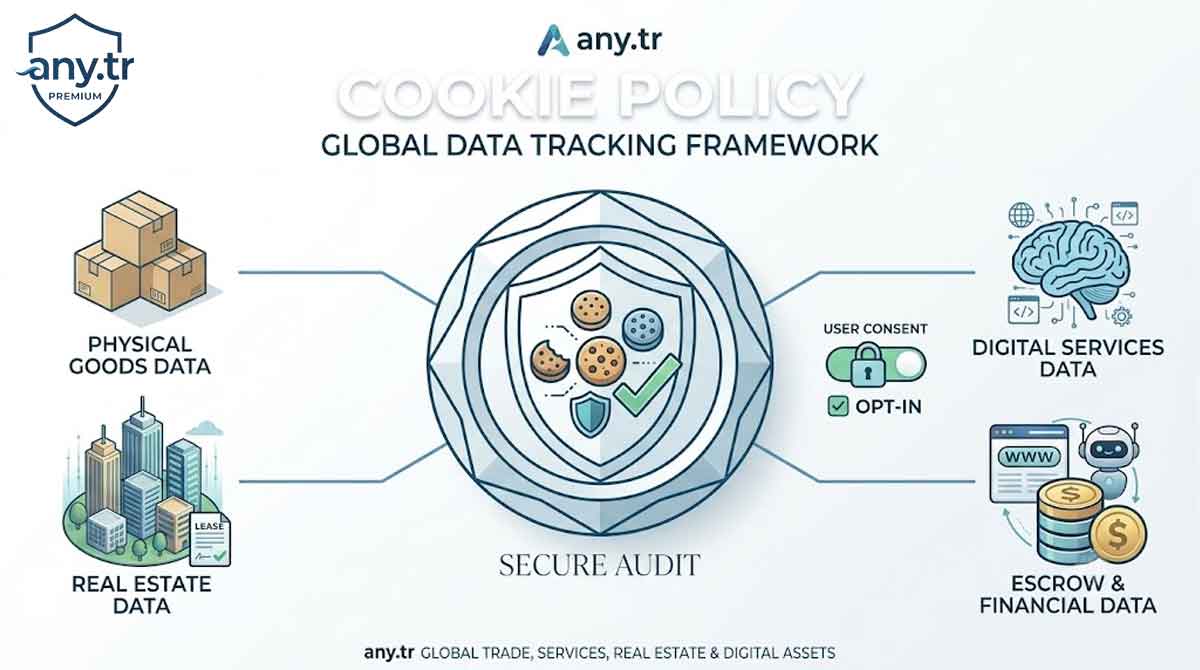
Comprehensive Cookie Policy and Global Data Tracking Framework
This comprehensive Cookie Policy explains in granular technical and legal detail how ANY.tr deploys, manages, and audits cookies, web beacons, tracking pixels, local storage objects, and related telemetry mechanisms. This tracking architecture is maintained across our global multi-vendor marketplace platform, including all associated localized subdomains, mobile interfaces, and integrated application programming interfaces (APIs). Our distributed venue connects independent commercial merchants, software engineers, freelance professionals, and real estate hosts with corporate and private international buyers. To sustain automated security protocols, maintain accurate cart states, and ensure compliance with cross-border privacy mandates, we must collect specific electronic identifiers from your terminal browsing device.
Understanding Tracking Tokens and Local Storage
Cookies are standardized alphanumeric text elements containing unique system identifiers that are automatically initialized and written to your computer, workstation, cellular terminal, or custom browser storage cache when interacting with specific web application nodes. These small records enable our host architecture to track state changes across stateless internet protocols, mapping your active session parameters, localized linguistic preferences, and identity permissions over predetermined temporal cycles. This structure guarantees that users do not encounter continuous re-authentication requests or profile drops while navigating between distinct multi-vendor directory loops.
In addition to standard browser cookies, ANY.tr utilizes modern tracking technologies including Web Beacons (clear graphic files used to verify document delivery states), HTML5 Local Storage (advanced local data caches that do not auto-expire with browser sessions), and Javascript Deployment Logs. These tools cooperate directly with our security core to analyze network telemetry, isolate automated scraping vectors, and verify that global cross-border transactions remain mathematically synchronized.
Global Regulatory Alignment and Sovereign Compliance Matrices
Because ANY.tr operates as a broad-scope, high-volume international marketplace, our tracking configurations are structurally aligned with major global data privacy frameworks. We proactively implement adaptive compliance layers to respect the sovereign consumer rights established across multiple economic zones. The architecture continuously checks incoming IP addresses and routing headers to enforce localized consent rules based on the following international regulatory frameworks:
| Regulatory Framework | Primary Jurisdiction | Consent Mechanism Enforced | User Rights Granted |
|---|---|---|---|
| General Data Protection Regulation (GDPR) | European Economic Area (EEA) | Strict opt-in consent before any non-essential script runs | Right to erasure, granular revocation, and complete access to recorded telemetry logs |
| California Consumer Privacy Act (CCPA/CPRA) | United States (California) | Opt-out authorization via structural “Do Not Sell My Info” links | Right to block automated data profiling and tracking pixel commercial transfers |
| Lei Geral de Proteção de Dados (LGPD) | South America (Brazil) | Explicit programmatic authorization loops for tracking scripts | Right to formal disclosure of active commercial processing nodes |
| Cross-Border Data Directives (APAC & MENA) | Asia-Pacific & Middle East Regions | Hybrid informational notification banners with dynamic opt-out controls | Localization controls ensuring data processing maps to secure regional cloud servers |
Granular Classification of Deployed Tracking Elements
The specific tracking scripts, pixel hooks, and database cookies operating across the ANY.tr digital marketplace are divided into four distinct operational tiers. Each tier handles specialized background tasks to support transactions, user interface states, or marketing pipelines:
Tracking TierTechnical Core FunctionsData Categories CapturedOperational Impact of Disabling
| Tier One: Strictly Necessary Cookies | Manages active account session states, maintains items in the checkout basket, routes secure split-payment data to escrow pools, and validates anti-fraud server requests. | Session tokens, encrypted user identification keys, IP address ranges, device signatures. | Critical Failure: The user dashboard becomes inaccessible, checkouts break, and multi-vendor registration forms will not submit. |
| Tier Two: Functional & Preference Cookies | Remembers localized currency conversions (USD, EUR, etc.), interface themes, saved geographical search areas for real estate, and layout settings for vendor store managers. | Currency strings, preferred language tags, historical search filters, hidden menu flags. | Moderate Degradation: Siteniz defaults to base English parameters and forces manual reconfiguration on every page reload. |
| Tier Three: Analytical & Performance Elements | Aggregates user flow data, measures CDN asset load speeds across different global nodes, identifies broken links, and logs checkout error rates. | Anonymized click paths, page latency metrics, bounce distribution analytics, operating system versions. | Negligible System Impact: Does not disrupt the core buying or selling processes; limits the technical team’s ability to optimize loading efficiency. |
| Tier Four: Targeting, Advertising & Retargeting | Builds behavioral interest graphs based on viewed freelance profiles, specific SaaS product queries, or real estate listings to display relevant updates on external networks. | Product interaction tags, category browsing loops, tracking pixels linked to advertising platforms. | Zero Operational Impact: Prevents generalized external promotional matching; does not lower site performance or security metrics. |
Vendor-Specific Cookie Obligations and Storefront Tracking Restrictions
Independent merchants who configure digital storefronts, link external APIs, or manage custom customer acquisition loops within the ANY.tr ecosystem must comply with our tracking standards. Vendors are strictly prohibited from embedding unauthorized third-party tracking pixels, hidden analytics scripts, or invisible iframe counters inside their product descriptions, markdown logs, or service portfolio assets.
If an enterprise merchant requests the integration of external tracking applications (such as advanced CRM webhooks or corporate marketing tags) to monitor their dedicated storefront traffic, they must submit a formal infrastructure request to our security review desk. All approved custom satıcı scripts are isolated within containerized sandboxes, ensuring they cannot access the authentication tokens, private billing records, or personal identity details of other global buyers browsing the platform.
Browser Management Framework and Cookie Purge Mechanics
Global consumers retain full authority over their individual data footprints. You can block, disable, modify, or completely clear cookie data by adjusting your web browser settings. Most modern applications allow you to reject all third-party cookies, enforce strict private browsing modes, or automatically wipe local storage histories when you close the active window.
To assist users in managing these browser parameters, the matrix below details the settings adjustments required across leading international browser applications:
| Browser Platform | Configuration Navigation Track | Recommended Retention Management Mode |
|---|---|---|
| Google Chrome / Chromium | Settings → Privacy and Security → Third-Party Cookies | Enable “Block third-party cookies” and set “Clear cookies and site data when you close all windows” to active. |
| Mozilla Firefox | Options → Privacy & Security → Enhanced Tracking Protection | Select “Strict Mode” and check the box for “Delete cookies and site data when Firefox is closed.” |
| Apple Safari (iOS & macOS) | Preferences → Privacy → Tracking & Cookies | Enable “Prevent cross-site tracking” and activate “Block all cookies” based on personal security mandates. |
| Microsoft Edge | Settings → Privacy, Search, and Services → Tracking Prevention | Set the tracking prevention level to “Balanced” or “Strict” to automatically restrict unknown external script behaviors. |
Modifications, Technical Updates, and Compliance Audits
We reserve the operational right to update, modify, or replace this Cookie Policy at any time to maintain structural alignment with evolving international privacy laws, shifts in cloud hosting infrastructure, or updates to our tracking scripts. We conduct bi-annual automated audits of all JavaScript tags, API endpoints, and database cookie lifecycles operating across the platform. The timestamp provided at the base of this page indicates the exact administrative version currently active across the system.
anytr, cookie policy, gdpr compliance, privacy framework, tracking pixel, data protection, multi vendor analytics, user consent, local storage, secure browsing